CCPC2026 黑龙江省大学生程序设计竞赛
F.复读机
签到题
G.卡卡数
统计 $[0,10^x-1]$ 中所有整数写成十进制后,数字 $1$ 出现的总次数,对
998244353取模。
签到题*2,答案为 $x\cdot 10^{\max(x-1,0)}\pmod{998244353}$。
H.周二会员日
给定 $x$,求 $4x-3$,读入形如 $a.bb$ 的字符串,数据范围 $(2<x\le4\times 10^{16})$,答案精确到小数点后两位.
为了防止 long double 爆精度,采用类似于高精度的写法,将 $x$ 扩大100倍后对字符串操作,实际上直接转成 unsigned long long 计算最后转回字符串即可。
1
2
3
4
5
6
7
8
9
10
11
12
13
14
15
16
17
18
19
20
21
22
23
24
25
26
27
28
29
30
31
32
#include<bits/stdc++.h>
#define int unsigned long long
using namespace std;
void sol(){
    string s;
    cin>>s;
    vector<int> num;
    for(auto ch:s){
        if(ch=='.') continue;
        num.push_back(ch-'0');
    }
    int sum(0);
    for(int i=0;i<(int)num.size();++i){
        sum+=num[i];
        if(i!=(int)num.size()-1) sum*=10ull;
    }
    int ans(sum*4-300);
    string answ("");
    int cnt(0);
    for(;ans;ans/=10){
        if(cnt==2) answ+='.';
        cnt++;
        answ+=(char)('0'+ans%10);
    }
    reverse(answ.begin(),answ.end());
    cout<<answ<<endl;
}
signed main(){
    int T(1);
    cin>>T;
    while(T--) sol();
}
M.六个核桃
给定 $m$,构造排列 $p$,最大化 $\sum \min(\lvert p_i-i\rvert,m)$.
不妨直接考虑没有 $m$ 的情况,为了让贡献最大,最简单的构造方法可以是倒序构造,此时的最大值即为 $\lfloor \frac{n^2}{2} \rfloor$,再有了 $m$ 的限制以后,我们当然希望构造出的差值尽量稳定,因此与倒序构造类似的可以采用平移构造,将原来的顺序序列向右平移轮换,注意到当平移轮换 $\lfloor \frac{n}{2} \rfloor$ 次以后答案最大,因此对于每个 $m$,考虑采用不同的平移策略。首先将顺序序列右平移轮换 $m$ 位得到 $n-m$ 个贡献为 $m$ 的位置,此时前 $m$ 位贡献均为 $n-m$,因此自然启示比较 $m$ 与 $n-m$ 的大小。对 $m$ 分类讨论。
- 当 $n-m\ge m$ 时,此时最大值为全部位均取上界 $m$,直接服用之前的轮换构造即可。
- 当 $n-m<m$ 时,对原来构造调整,首先后 $n-m$ 位贡献恰好卡到上界 $m$,则考虑前 $n-m$ 位,为了让贡献卡到上界的位置尽量多,因此对前 $n-m$ 位的每一位 $i$ 构造 $p_i=i+m$,直到 $i=n-m$。现在还剩下 $n-m$ 到 $m$ 位置,直接采用局部的倒序构造或者平移轮换一半构造即可。
1
2
3
4
5
6
7
8
9
10
11
12
13
14
15
16
17
#include<bits/stdc++.h>
using namespace std;
int main(){
    int n,m;
    cin>>n>>m;
    vector<int> a(n+10);
    if((m<<1)<=n){
        for(int i=m+1;i<=n;++i) a[i]=i-m;
        for(int i=1;i<=m;++i) a[i]=i+n-m;
        for(int i=1;i<=n;++i) cout<<a[i]<<' ';
    }else{
        for(int i=m+1;i<=n;++i) a[i]=i-m;
        for(int i=1;i<=n-m;++i) a[i]=i+m;
        for(int i=n-m+1;i<=m;++i) a[i]=n+1-i;
        for(int i=1;i<=n;++i) cout<<a[i]<<' ';
    }
}
C.圆桌会议
构造 $1$ 到 $n$ 环形排列,是每个连续三人组的中位数种类尽量少。
感觉很难用语言描述清楚,首先为了得到最优答案,很容易可以想到”中-低-中-高-中”这种构造(或者反过来)可以使中间的三位中位数相同。因此直接就能想到对于 $n=6$ 时有 456123,此时的中位数种类为4,观察一下,因为首尾的”中-低-中-高-中”构造被破坏了,所以产生了两个多余贡献。为了维护这个结构不被破坏,就需要尾位高于首位,从而完成衔接,因此原来的紧密放置不合理,需要插空放置。
如何考虑插空策略?显然还是以每三个位置为一组,逐渐升高即可。实际上画图还是可以理解的,语言描述颇为抽象。。。
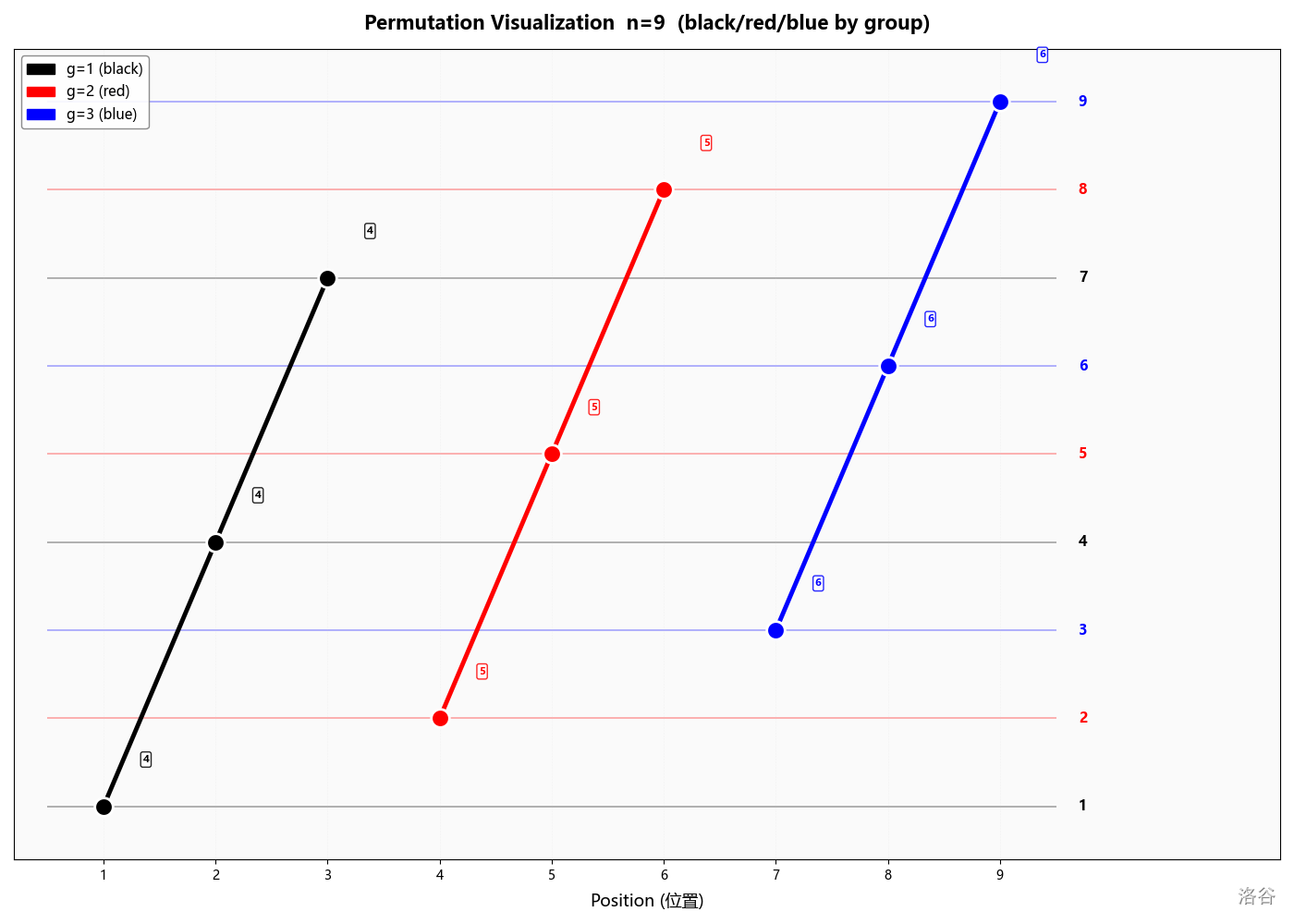
接下来只要对 n%3 分类讨论即可,注意只有当 n%3==1 时才需要特殊处理,也就是最后一个数为了不破坏先前的所有结构,就需要放在最后一组的中位数之下,第一组的中位数之上,然后将先前所有比最后一个数大的数向上平移一位(加一)即可。
1
2
3
4
5
6
7
8
9
10
11
12
13
14
15
16
17
18
19
20
21
22
23
24
25
26
27
28
29
30
31
32
33
#include<bits/stdc++.h>
using namespace std;
void sol(){
    int n,res,g;
    cin>>n;
    vector<int> a(n+10);
    res=n%3,g=n/3;
    if(!res){
        for(int i=1;i<=g;++i)
            for(int j=0;j<3;++j)
                cout<<i+g*j<<' ';
    }else if(res==2){
        g++;
        for(int i=1;i<g;++i)
            for(int j=0;j<3;++j)
                cout<<i+g*j<<' ';
        cout<<g<<' '<<2*g<<' ';
    }else{
        for(int i=1;i<=g;++i){
            for(int j=0;j<3;++j){
                int fac(i+g*j);
                cout<<fac+(fac>1+g)<<' ';
            }
        }
        cout<<2+g<<' ';
    }
    cout<<'\n';
}
int main(){
    int T(1);
    cin>>T;
    while(T--) sol();
}
B.最大数码 2
给定区间 $[l,r]$,求 $f(x)$ 的最大值,并在达到最大值的 $x$ 中输出十进制字符串字典序最小者。其中 $f(x)$ 表示正整数 $x$ 十进制下表示的最大数码。
称长度为 $x$ 的字符串 $P$ 的字典序小于长度为 $y$ 的字符串 $Q$,若:$x<y$ 且对于所有 $1≤i≤x$ 有 $p_i=q_i$,或者存在一个整数 $1≤t≤\min(x,y)$,对于所有 $1≤i<t$ 有 $p_i=q_i$,且 $p_t<q_t$。
关键在于字典序的定义有些不同,因此字典序和数值大小没有关系。比如 10009 的字典序要比 1009 更小,因此尽可能地让 $1000…$ 填充更高位更优。
同时注意到当区间长度大于 $10$ 时,必有 $f(x)=9$,自然启示对区间长度分类讨论。
- 当区间长度小于 $10$ 时,直接暴力枚举即可。
- 当区间长度大于等于 $10$ 时,为了尽可能地让 $1000…$ 填充更高位,不妨先在区间内寻找最大的
1000...009,必然最优。如果不存在1000...009,意味着区间长度不跨越不同位数,此时直接在 $l$ 的基础上构造即可。1 2 3 4 5 6 7 8 9 10 11 12 13 14 15 16 17 18 19 20 21 22 23 24 25 26 27 28 29 30 31 32 33 34 35 36 37 38 39 40 41 42 43 44 45 46 47 48 49 50 51 52 53 54 55 56 57 58 59 60 61 62 63 64 65 66 67 68 69 70 71 72
#include<bits/stdc++.h> using namespace std; #define int long long void sol(){ int l,r; cin>>l>>r; if(r-l<10){ auto cmp=[&](string a,string b){ int sia(a.size()),sib(b.size()); int siz(max(sia,sib)); int d(abs(sia-sib)); if(sia>sib){ for(int i=0;i<d;++i) b+='0'; }else{ for(int i=0;i<d;++i) a+='0'; } for(int i=0;i<siz;++i){ int na(a[i]-'0'),nb(b[i]-'0'); if(na<nb) return true; else if(na>nb) return false; else continue; } return sib>sia; }; auto f=[&](int x){ int ans(0); for(;x;x/=10) ans=max(ans,x%10); return ans; }; string anss("999999999"); int ans(0); for(int i=l;i<=r;++i) ans=max(ans,f(i)); for(int i=l;i<=r;++i){ string s(""); int num=i; for(;num;num/=10){ int dig=num%10; s+=(char)(dig+'0'); } reverse(s.begin(),s.end()); bool flag(0); for(auto digi:s){ if(digi-'0'==ans){flag=1;break;} } if(flag&&cmp(s,anss)) anss=s; } cout<<ans<<' '<<anss<<'\n'; }else{ int sta(0); for(int i=1;;i*=10){ if(i==1) sta=9; else sta=i+9; if(i*10+9>r) break; } if(sta>=l) cout<<9<<' '<<sta<<'\n'; else{ bool flag(0); for(int num(l);num;num/=10){ int dig=num%10; if(dig==9){flag=1;break;} } if(flag) cout<<9<<' '<<l<<'\n'; else cout<<9<<' '<<l/10*10+9<<'\n'; } } } signed main(){ int T(1); cin>>T; while(T--) sol(); }
J.秋水横渡
有 $n$ 座周期性开闭关口,关口会在”开启”和”关闭”两种状态之间交替切换,每次维持某一状态的时间均为 $k$ 个单位时间(即一个完整的开闭周期长度为 $2k$),每座关口相位可预设为 $S_i$,当关口处于开启状态时,竹筏可以瞬间渡过(不花费时间);当关口处于关闭状态时,竹筏必须在关口前等待,直到关口切换为开启状态方可通行。存在全局随机偏移量 $\Delta\in(0,2k)$ 使得各门相位延迟。已知竹筏会采取最完美的策略来设定所有的 $S_i$ 以最小化行程耗时,同时每个门之间耗时给定为 $t_i$。求最小期望总耗时。
诈骗题。实际上先考虑没有 $\Delta$ 的情况,此时将 $S_i$ 设置为某个恰好开门的时段往前回溯 $pre_i$ 这个相位,可以使得竹筏在通过首门以后一路畅通无阻,即每次到达门都刚好迎来门的”初开“相位。
现在考虑加上 $\Delta$,由于 $\Delta\in(0,2k)$,当 $\Delta\in(0,k)$ 时,此时相当于没有在第一道门等待,因此其后的所有门相位从”初开“加上 $\Delta$ 后仍然处于开门状态。当 $\Delta\in(k,2k)$ 时,此时需要在第一道门等待至开门,总偏移量(在第一道门等待的时间加 $\Delta$)恰好可以使其后的所有门继续满足没有 $\Delta$ 的”一路畅通“状态。
因此唯一要考虑的即为在第一道门等待时间的期望,因变量为 $\Delta$,自变量为等待时间,很容易积分出期望为 $\frac{k}{4}$.
因此答案即为 $\sum_i t_i+\frac{k}{4}$。
E.乐乐的杏花
树上点动态开关,当前位置沿边移动,每个时刻查询离当前位置最近的盛开杏花距离。
很基础的树链剖分加线段树维护,维护所有点到当前根节点的距离,取全局最小即可。(太久没写树剖LCA都写瓜了)
1
2
3
4
5
6
7
8
9
10
11
12
13
14
15
16
17
18
19
20
21
22
23
24
25
26
27
28
29
30
31
32
33
34
35
36
37
38
39
40
41
42
43
44
45
46
47
48
49
50
51
52
53
54
55
56
57
58
59
60
61
62
63
64
65
66
67
68
69
70
71
72
73
74
75
76
77
78
79
80
81
82
83
84
85
86
87
88
89
90
91
92
93
94
95
96
97
98
99
100
101
102
103
104
105
106
107
108
109
110
111
112
113
114
115
116
117
118
119
120
121
122
123
124
125
126
127
128
129
130
131
#include<bits/stdc++.h>
// #define int long long
#define inf 1e6+10
using namespace std;
const int N=1e5+10;
int n,m,rt(1);
int to[N<<1],head[N],nxt[N<<1];
int fa[N],dep[N],siz[N],dfn[N],rev[N],top[N],son[N];
void add(int u,int v){
to[++to[0]]=v,nxt[to[0]]=head[u],head[u]=to[0];
to[++to[0]]=u,nxt[to[0]]=head[v],head[v]=to[0];
}
void dfs1(int u,int f){
dep[u]=dep[fa[u]=f]+(siz[u]=1);
for(int i=head[u];i;i=nxt[i]){
if(to[i]==f) continue;
dfs1(to[i],u);
siz[u]+=siz[to[i]];
if(siz[to[i]]>=siz[son[u]]) son[u]=to[i];
}
}
void dfs2(int u,int tp){
top[rev[dfn[u]=++dfn[0]]=u]=tp;
if(son[u]) dfs2(son[u],tp);
for(int i=head[u];i;i=nxt[i]){
if(to[i]^fa[u]&&to[i]^son[u]){
dfs2(to[i],to[i]);
}
}
}
int LCA(int x,int y){
for(;top[x]^top[y];){
if(dep[top[x]]<dep[top[y]]) swap(x,y);
x=fa[top[x]];
}
return dep[x]<dep[y]?x:y;
}
namespace TREE{
#define lson pos<<1
#define rson pos<<1|1
struct Node{
int dat,tag;
}t[N<<2];
void push_up(int pos){
t[pos].dat=min(t[lson].dat,t[rson].dat);
}
void add_tag(int pos,int v){
t[pos].tag+=v;
t[pos].dat+=v;
}
void push_down(int pos){
if(!t[pos].tag) return;
add_tag(lson,t[pos].tag);
add_tag(rson,t[pos].tag);
t[pos].tag=0;
}
void build(int pos,int l,int r){
if(l==r) return t[pos].dat=inf,void();
int mid((l+r)>>1);
build(lson,l,mid);
build(rson,mid+1,r);
push_up(pos);
}
void mdy(int pos,int l,int r,int x,int v){
if(l==r) return t[pos].dat=v,t[pos].tag=0,void();
push_down(pos);
int mid((l+r)>>1);
if(x<=mid) mdy(lson,l,mid,x,v);
else mdy(rson,mid+1,r,x,v);
push_up(pos);
}
void modify(int pos,int l,int r,int ql,int qr,int v){
if(ql<=l&&r<=qr) return add_tag(pos,v);
push_down(pos);
int mid((l+r)>>1);
if(ql<=mid) modify(lson,l,mid,ql,qr,v);
if(mid<qr) modify(rson,mid+1,r,ql,qr,v);
push_up(pos);
}
}
bool sta[N];
signed main(){
ios::sync_with_stdio(false);
cin.tie(0),cout.tie(0);
cin>>n>>m;
for(int i=1;i<n;++i){
int u,v;
cin>>u>>v;
add(u,v);
}
dfs1(1,0);
dfs2(1,1);
for(int i=1;i<=n;++i) dep[i]--;
TREE::build(1,1,n);
while(m--){
int opt,x;
cin>>opt>>x;
if(opt==1){
if(sta[x]){
TREE::mdy(1,1,n,dfn[x],inf);
}else{
int d;
if(dfn[rt]<=dfn[x]&&dfn[x]<=dfn[rt]+siz[rt]-1){
d=abs(dep[rt]-dep[x]);
}else if(dfn[x]<=dfn[rt]&&dfn[rt]<=dfn[x]+siz[x]-1){
d=abs(dep[rt]-dep[x]);
}else{
int lca=LCA(x,rt);
d=dep[rt]+dep[x]-2*dep[lca];
}
TREE::mdy(1,1,n,dfn[x],d);
}
sta[x]^=1;
int ans(TREE::t[1].dat);
if(ans>=N) cout<<2147483648<<'\n';
else cout<<TREE::t[1].dat<<'\n';
}else{
if(dep[rt]>=dep[x]){
TREE::modify(1,1,n,1,n,-1);
TREE::modify(1,1,n,dfn[rt],dfn[rt]+siz[rt]-1,2);
}else{
TREE::modify(1,1,n,1,n,1);
TREE::modify(1,1,n,dfn[x],dfn[x]+siz[x]-1,-2);
}
rt=x;
int ans(TREE::t[1].dat);
if(ans>=N) cout<<2147483648<<'\n';
else cout<<TREE::t[1].dat<<'\n';
}
}
}
A.卡卡杀
树上有不超过 3000 个节点和 3000 名玩家。玩家按最短路逐时刻移动;同点玩家按阵营和冷却规则互相击杀,最后输出存活玩家.
题面太长了,总体来说是一个中模拟,模拟每个时刻的时间并对每个点更新状态,总体时间复杂 $\Theta(n^2)$。具体而言,首先需要处理出每个玩家的路径点集:预处理深度和父亲节点数组,然后找起终点 LCA(s,t),向最近公共祖先跳 fa[x] 即可,因为复杂度瓶颈不在求 $\text{LCA}$,因此直接暴跳即可
。接下来就是按照题目中的要求顺序处理每个事件发生的事件,有一些细节要注意:
- 每次更新对所有节点开桶维护当前节点玩家集合,优先处理当前获胜玩家,他们不需要计入当前节点玩家集合列表。
- 处理“卡卡”以外所有玩家状态,跟据当前时间戳分类四种玩家“击杀贡献”,注意“鹅”玩家杀死“卡卡”后“卡卡”击杀贡献直接置零。同时计数“中立”玩家击杀贡献数,若中立击杀贡献至少为 $2$,意味着中立玩家之间必然无人生还;若中立击杀贡献为 $1$,意味着只有一名中立玩家出刀,则当前出刀中立玩家不受伤害。
- 处理“卡卡”伤害,若“卡卡”击杀贡献仍存在,则击杀其他存活玩家。
最后统计所有获胜玩家即可。
1
2
3
4
5
6
7
8
9
10
11
12
13
14
15
16
17
18
19
20
21
22
23
24
25
26
27
28
29
30
31
32
33
34
35
36
37
38
39
40
41
42
43
44
45
46
47
48
49
50
51
52
53
54
55
56
57
58
59
60
61
62
63
64
65
66
67
68
69
70
71
72
73
74
75
76
77
78
79
80
81
82
83
84
85
86
87
88
89
90
91
92
93
94
95
96
97
98
99
100
101
102
103
#include<bits/stdc++.h>
using namespace std;
const int N=3010;
int n,m;
int to[N<<1],head[N],nxt[N<<1];
int fa[N],dep[N];
vector<int> G[N];
void add(int u,int v){
to[++to[0]]=v,nxt[to[0]]=head[u],head[u]=to[0];
to[++to[0]]=u,nxt[to[0]]=head[v],head[v]=to[0];
}
void dfs(int u,int f){
dep[u]=dep[fa[u]=f]+1;
for(int i=head[u];i;i=nxt[i]){
if(to[i]==f) continue;
dfs(to[i],u);
}
}
int LCA(int x,int y){
vector<int> p;
for(;x^y;){
if(dep[fa[x]]<dep[fa[y]]) swap(x,y);
x=fa[x];
}
return dep[x]<dep[y]?x:y;
}
struct gamer{
int op,tim,s,t,pos;
vector<int> p;
bool w,d;
}a[N];
bool upd(int T){
vector<vector<int>> G(n+10);
bool done(1);
for(int i=1;i<=m;++i){
if(a[i].w||a[i].d) continue;
done=0;
a[i].pos++;
if(a[i].pos==(int)a[i].p.size()-1){
a[i].w=1;
continue;
}
G[a[i].p[a[i].pos]].push_back(i);
}
if(done) return 1;
bool g[5];
for(int u=1;u<=n;++u){
g[1]=g[2]=g[3]=g[4]=0;
int cnt_m(0);
for(auto v:G[u]){
if(!(T%a[v].tim)){
cnt_m+=(a[v].op==4);
g[a[v].op]|=1;
}
}
for(auto v:G[u]){
if(a[v].op==1){
a[v].d|=g[2];
if(a[v].d) g[1]=0;
}
if(a[v].op==2) a[v].d|=(g[3]|g[4]);
if(a[v].op==3) a[v].d|=g[4];
if(a[v].op==4){
if(cnt_m>=2) a[v].d=1;
else if(cnt_m==1&&T%a[v].tim) a[v].d=1;
}
}
for(auto v:G[u]){
if(a[v].d) continue;
if(a[v].op!=1) a[v].d|=g[1];
}
}
return done;
}
int main(){
cin>>n>>m;
for(int i=1;i<n;++i){
int u,v;cin>>u>>v;
add(u,v);
}
dfs(1,0);
for(int i=1;i<=m;++i){
int op,tim,s,t;
vector<int> p;
cin>>op>>tim>>s>>t;
a[i]={op,tim,s,t,0,p,0,0};
int lca(LCA(s,t));
int x(s),y(t);
vector<int> p2;
for(;dep[x]>=dep[lca];x=fa[x]) a[i].p.push_back(x);
for(;dep[fa[y]]>=dep[lca];y=fa[y]) p2.push_back(y);
reverse(p2.begin(),p2.end());
for(auto val:p2) a[i].p.push_back(val);
}
for(int T(1);;T++){
if(upd(T)) break;
}
int sum(0);
for(int i=1;i<=m;++i) sum+=a[i].w;
cout<<sum<<'\n';
for(int i=1;i<=m;++i)
if(a[i].w) cout<<i<<'\n';
}
L.猪猪车
交互猜四位数。一次询问返回位置和数码完全相同的位数,要求 $12$ 次询问内猜出答案。
学到了 $\text{minimax}$ 搜索,首先,为了缩小待选择集合,可以先用最多 $9$ 次询问 $0000\cdots8888$ 得到答案的构成集合,自然可以得到答案的不同分类 abcd aabc aabb aaab,由不同分类可以将正确答案集合映射为这四种统一构造。接下来为了在 $3$ 次询问内得到正确答案,需要寻找最优的策略,使得每一次询问都能将当前可能的答案最均匀分割,即利用 $\text{minimax}$ 搜索。
因为总共的可能性并不太多,因此我们可以将最后三次的决策树暴力搜出来,然后离线查表即可,因此如何制表是关键。我们对当前节点分别记录个内容:当前节点的编号,当前节点的儿子节点编号,当前节点的可能答案集合,显然当可能答案集合只有一个可能答案时(即叶子节点)就是我们要输出的值。那么在向下递归时,需要划分当前答案集合,显然需要利用题目中的“相等个数”也就是每一次机器反馈的值划分,为了实现之前的最优划分,我们需要找到一个问题,使得当前节点下询问这个问题后,最小化儿子节点的可能答案集合大小最大值,也就是尽量让这个问题效率最高。同样的,因为样本数量几乎为常数级别,直接暴力寻找即可。
然后在在线的讯问中,利用之前离线生成的表,按照每次的机器反馈值在决策树上游走,直到走到叶子节点,回答答案即可。
一些需要注意的细节;
- 因为所有答案被归一化成四种情况,因此在回答需要按照映射情况将答案映射回去。
- 每次的询问问题不一定出自于当前答案集合,直接从全局所有答案中(共 $256$ 种)枚举选择即可,但要注意不要让映射数组溢出,最方便的方法就是直接不管任何情况,在保证归一化模型的个数满足下,任意挑选其余没有出现的数字将映射数组填满 $4$ 个。
- 在当前数字个数已经满 $4$ 的情况下,没有必要把之后的确定个数问题全部问完,直接开始下一步即可。
- 确定 $9$ 的个数以后同样需要确定是否为
9999。
1
2
3
4
5
6
7
8
9
10
11
12
13
14
15
16
17
18
19
20
21
22
23
24
25
26
27
28
29
30
31
32
33
34
35
36
37
38
39
40
41
42
43
44
45
46
47
48
49
50
51
52
53
54
55
56
57
58
59
60
61
62
63
64
65
66
67
68
69
70
71
72
73
74
75
76
77
78
79
80
81
82
83
84
85
86
87
88
89
90
91
92
93
94
95
96
97
98
99
100
101
102
103
104
105
106
107
108
109
110
111
112
113
114
115
116
117
118
119
120
121
122
123
124
125
126
127
128
129
130
131
132
133
134
135
136
137
138
139
140
141
142
143
144
145
146
147
148
149
150
151
152
153
154
155
156
#include<bits/stdc++.h>
#define pii pair<int,int>
using namespace std;
const int N=500;
int rt[4],rcnt(0);
vector<pii> d;
vector<int> sta;
struct Node{
    int q;
    int son[5];
    vector<int> ans;
}t[4][N];
int bulls(int S,int T){
    int sum(0);
    for(int tim(4);tim--;){
        sum+=((S%10)==(T%10));
        S/=10,T/=10;
    }
    return sum;
};
int B(int qry,vector<int> s){
    int maxn(0);
    int se[5]={0,0,0,0,0};
    for(auto val:s) se[bulls(qry,val)]++;
    maxn=max({se[0],se[1],se[2],se[3],se[4]});
    return maxn;
}
void dfs(int &pos,vector<int> s,int opt){
    if(!s.size()) return pos=-1,void();
    if(!pos){
        pos=++rcnt;
        memset(t[opt][pos].son,0,sizeof(t[opt][pos].son));
    }
    t[opt][pos].ans=s;
    if(s.size()==1) return;
    int minn(100),qry(0);
    for(auto val:sta){
        if(minn>B(val,s)){
            minn=B(val,s);
            qry=val;
        }
    }
    t[opt][pos].q=qry;
    vector<int> cla[5];
    for(auto val:s){
        int cnt=bulls(qry,val);
        cla[cnt].emplace_back(val);
    }
    for(int i=0;i<=4;++i) dfs(t[opt][pos].son[i],cla[i],opt);
}// 0001
void print(int num,char ch){
    cout<<ch<<' ';
    string s("");
    for(int i=1;i<=4;++i){
        s+=char(d[num%10].second+'0');
        num/=10;
    }
    reverse(s.begin(),s.end());
    cout<<s<<endl;
    cout.flush();
    return;
}
void query(int op){
    int pos(rt[op]);
    for(;pos>0&&t[op][pos].ans.size()!=1;){
        print(t[op][pos].q,'?');
        int val;cin>>val;
        pos=t[op][pos].son[val];
    }
    if(pos>0&&t[op][pos].ans.size()==1) print(t[op][pos].ans[0],'!');
    return;
}
void sol(){
    d.clear();
    vector<int> cnt(10);
    int sum(0);
    for(int i=0;i<9;++i){
        cout<<"? "<<i<<i<<i<<i<<endl;
        cin>>cnt[i];
        if(cnt[i]==4){
            cout<<"! "<<i<<i<<i<<i<<endl;
            return;
        }
        sum+=cnt[i];
        if(sum==4) break;
    }
    cnt[9]=4-sum;
    if(cnt[9]==4){
        cout<<"! 9999"<<endl;
        return;
    }
    bool f3(0);
    int op(-2);
    for(int i=0;i<=9;++i){
        if(cnt[i]) d.emplace_back(cnt[i],i),op++;
        if(cnt[i]==3) f3=1;
    }
    for(int i=0;i<=9;++i){
        if(cnt[i]) continue;
        if(d.size()<4) d.emplace_back(cnt[i],i);
        else break;
    }
    sort(d.begin(),d.end(),greater<pii>());
    if(!op&&!f3) op=3;
    query(op);
    cout.flush();
}
void init(int op){
    vector<function<void(int&,vector<int>,int)>> dfss={dfs,dfs,dfs,dfs};
    vector<int> rts;
    if(!op){
        rts.emplace_back(1);
        rts.emplace_back(10);
        rts.emplace_back(100);
        rts.emplace_back(1000);
    }
    else if(op==1){
        rts.emplace_back(12),rts.emplace_back(21);
        rts.emplace_back(102),rts.emplace_back(201);
        rts.emplace_back(120),rts.emplace_back(210);
        rts.emplace_back(1002),rts.emplace_back(2001);
        rts.emplace_back(1020),rts.emplace_back(2010);
        rts.emplace_back(1200),rts.emplace_back(2100);
    }else if(op==2){
        rts.emplace_back(123),rts.emplace_back(132),rts.emplace_back(231);
        rts.emplace_back(213),rts.emplace_back(312),rts.emplace_back(321);
        rts.emplace_back(1023),rts.emplace_back(1032),rts.emplace_back(1230);
        rts.emplace_back(1203),rts.emplace_back(1302),rts.emplace_back(1320);
        rts.emplace_back(2013),rts.emplace_back(2031),rts.emplace_back(2130);
        rts.emplace_back(2103),rts.emplace_back(2301),rts.emplace_back(2310);
        rts.emplace_back(3012),rts.emplace_back(3021),rts.emplace_back(3120);
        rts.emplace_back(3102),rts.emplace_back(3201),rts.emplace_back(3210);
    }
    else{
        rts.emplace_back(1100);
        rts.emplace_back(1010);
        rts.emplace_back(1001);
        rts.emplace_back(110);
        rts.emplace_back(101);
        rts.emplace_back(11);
    }
    dfss[op](rt[op],rts,op);
}
void dfs_s(int k,int tmp){
    if(k==5) return sta.push_back(tmp);
    for(int i=0;i<=3;++i){
        dfs_s(k+1,tmp*10+i);
    }
}
int main(){
    int T(1);
    dfs_s(1,0);
    for(int i=0;i<=3;++i) init(i);
    cin>>T;
    while(T--) sol();
}